UGC Meaning: What Is UGC and What Do UGC Creators Do?
Oct 13, 2026 · 8 min read
- UGC means user-generated content: video that looks made by a real person, not the brand.
- A UGC creator is paid for the video, not for followers.
- The main types are traditional, Canvas, tech/app and faceless UGC.
- Pay is per video, per 1,000 views (CPM), a monthly retainer, or a mix.
UGC means user-generated content: photos, videos and reviews made by people rather than by the brand. In marketing today, UGC usually means short, natural-looking videos that brands pay creators to make. A UGC creator is the person who makes them, and you don’t need followers to do the job.
This guide covers what UGC is, how a UGC creator differs from an influencer, the main types of UGC work, how creators get paid and how to start. (In India, UGC is also the University Grants Commission. This guide is about user-generated content.)
What UGC means
The term comes from the early social web. In 2007 the OECD defined user-created content as content that is made publicly available online, reflects “a certain amount of creative effort”, and is “created outside of professional routines and practices.” Think product reviews, unboxing videos and customer photos.
That last part is what changed. On social feeds, brands want videos that look like a person made them, not an ad agency. TikTok now sells brands a tool, Content Suite, to “discover, activate, and scale UGC into high-performing ads.” And brands started paying people to make videos in that same style.
Today “UGC” covers two different things:
- Organic UGC: unpaid posts by real customers. A brand may ask to repost them.
- Paid UGC: videos a brand pays a creator to make in the same natural style. This is what “UGC creator” and “UGC jobs” refer to.
One marketplace shows the shift: on Collabstr, UGC made up 35% of campaigns in 2025, up from 15% the year before. The rest of this guide is about paid UGC.
What is UGC content?
UGC content is the videos and photos themselves. The common short-video formats:
- Talking to camera: a review, a testimonial, “3 things I like about this.”
- Unboxing and first try: opening the product and reacting on camera.
- How-to: showing one feature, step by step.
- Before and after: the problem, then the result.
- Reaction plus demo: a quick reaction shot, then a screen recording of an app. This is the core of tech UGC.
Brands use these in paid ads, on their own social accounts, on product pages and in emails. Where they can use your video, and for how long, is set by the usage rights in your deal.
What is a UGC creator?
A UGC creator is a freelancer paid by brands to make that kind of video. Most of the work follows one loop. The brand sends a brief. You film on your phone. You edit and add a hook, the line on screen that stops the scroll. Then you deliver the file, or post it yourself on a brand account.
You don’t need a following. Billo, one of the larger UGC marketplaces, says there’s “no following required to start”. Its creators must be 18 or older and live in the US, Canada or the UK. You’re paid for the video, not for your audience.
You’ll usually work as an independent contractor, not an employee. Platforms like Sideshift collect a W-9 and issue 1099s, the US forms for contractors. You invoice per deal and handle your own taxes. The full money picture is in how much UGC creators make in 2026.
UGC creator vs influencer
The short version: influencers sell reach, UGC creators sell videos.
Influencer
paid for the audience
- Posts on their own account
- Rate depends on followers and reach
- The brand rents their audience
- Has to build and keep a following
UGC creator
paid for the video
- The brand posts it, runs it as an ad, or you post it on the brand’s account
- Rate depends on the video, the volume and the usage rights
- The brand buys the video
- Zero followers is fine
The lines blur. A brand can run your video as an ad through your own account, which is called whitelisting. Some influencers also sell UGC on the side. But the core deal is different. An influencer’s price moves with their follower count. A UGC creator’s price moves with what the brand gets to do with the video.
Types of UGC work
Traditional UGC
A brand sends a brief or a script. You film, edit, handle revisions and deliver the files. The brand posts them or runs them as ads. These are usually one-off jobs, paid per video. See Canvas UGC vs traditional UGC for the full comparison.
Canvas UGC
You post videos yourself on a social account the brand owns, often starting at zero followers, usually every day. Creator Mackenzie Marsh says she named it in April 2025. Pay is often per post, per 1,000 views, or a monthly retainer. Start with Is Canvas UGC legit? or the short glossary entry.
Tech and app UGC
Tech UGC promotes apps and software. Most of it follows one formula: a reaction shot, an app demo, and a hook on screen the whole time.

Reaction
App demo
Hook
this app planned my whole week in 10 seconds
@yourbrand
original sound — yourbrand
One video
The app changes from client to client. The formula doesn’t. That’s why tech UGC creators film a folder of reaction clips once and reuse them across many posts, with a new demo and a new hook each time.
Faceless UGC
Faceless UGC never shows your face. Hands, product shots, screen recordings, voiceover and on-screen text do the work. It’s good for privacy. But some brands want a face for trust, so it narrows your options.
These types overlap. A tech UGC deal is often a Canvas deal too, and a tech video where the demo carries most of the screen time is close to faceless.
How UGC creators get paid
There are three models, and many deals mix them:
Per video
$50–$500+
per accepted video
A flat fee per video. Usage rights for ads are usually billed on top.
+ Predictable per job
− Capped by how many briefs you land
CPM
$1–$8
per 1,000 views
Paid on views, common when you post on a brand account.
+ Upside when a video takes off
− Slow on new accounts
Retainer
~$500
median monthly base (Canvas)
A fixed monthly fee for an agreed volume, often with view bonuses.
+ A floor you can plan on
− Daily volume is in the contract
Where those numbers come from:
- Per video. Billo puts entry-level rates at $50 to $100 per video, mid-level at $150 to $500, and established creators at $500 or more before licensing. Collabstr reports an average UGC campaign cost of $197 in 2025, down from $209 a year earlier.
- Per post on Canvas deals. Marsh reports $20 to $55 per video among creators she works with.
- CPM. Marsh cites $1 to $5 per 1,000 views. Elev8or cites $2 to $8. Read the UGC CPM entry for how it’s calculated.
- Retainers. viral.app reports a median Canvas base of about $500 a month, with bonuses when videos pass view milestones. See UGC retainer.
- Usage rights. Sideshift’s guide prices paid ad use at 25% to 50% of the base rate for a 30- to 90-day window, on top of the video itself.
Your monthly income depends less on any one rate than on how many deals you can run at once, and how long each video takes you.
How to become a UGC creator
- 1 Pick a lane Traditional, Canvas, tech or faceless. You can change later.
- 2 Make 3–5 sample videos Use products you own or apps you already use.
- 3 Put them behind one link A simple portfolio page a brand can open on a phone.
- 4 Apply and pitch Free platforms first, then brands directly.
- 5 Set rates and get it in writing Volume, pay date, usage rights and who owns the account.
Make samples in the format you want to sell. Brands want proof you can hold attention in the first seconds. For tech UGC, that’s a reaction shot, a screen recording of an app you use, and a hook. The free hook generator gives you a starting list to edit into your own voice.
Apply where it’s free. Sideshift is free to join for creators and charges brands instead. On Billo, each task has a set payout you can see before applying. You can also pitch app and product brands directly by email or DM, with your sample link.
Price your time, not just the video. Before you accept a deal, work out how many hours it takes per month. A $30 post that takes you two hours is a worse deal than it looks.
Disclose paid posts. Paid videos need a clear disclosure in the US, even when they’re built to look organic. The FTC’s Disclosures 101 for influencers is the plain-language guide. It applies to creators outside the US too when “it’s reasonably foreseeable that the post will affect U.S. consumers.” BBB National Programs argues the same rules cover Canvas UGC, and that brands can be liable as well.
This is general information, not legal advice.
What the work looks like once you start
The first deal is the hard part. After that, the limit is time.
Traditional UGC is a stream of separate briefs: read, film, edit, revise, deliver, find the next one. Canvas and tech UGC are a daily loop instead: new hook, edit, caption, post, for every client account. One post a day for a month is 30 videos per client. Three clients at two posts a day is 180.
That loop is what caps how many clients you can take. Two guides go deeper: how to post 3 times a day as a UGC creator, and stacking retainer UGC deals for running several brands at once.
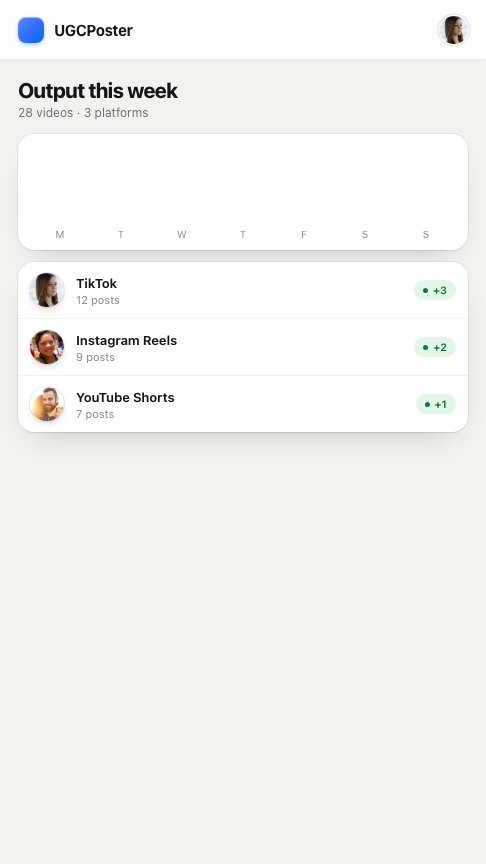
If you go the Canvas or tech route, UGCPoster handles that daily loop. You upload your reaction clips and app demos once. Each run pairs a reaction with a demo, writes a fresh hook, renders the video and posts it to TikTok, Instagram Reels or YouTube Shorts. It doesn’t find deals or film anything for you.
UGC has simple economics: brands pay for videos that look like a person made them. Learn the formats, make a few samples, and price your hours before you price your videos.
FAQ
What does UGC stand for? +
UGC stands for user-generated content: photos, videos and reviews made by people rather than by the brand. In marketing it now also means short videos that brands pay creators to make in that same natural style.
What is a UGC creator? +
A UGC creator is a freelancer paid by brands to make short, natural-looking videos about a product. The brand posts them or runs them as ads, or the creator posts them on an account the brand owns.
Do you need followers to be a UGC creator? +
No. Brands pay for the video, not your audience. Billo, one of the larger UGC marketplaces, says no following is required to start. In Canvas UGC you post on a brand account that often starts at zero followers.
What is the difference between UGC and influencer marketing? +
An influencer is paid for their audience and posts on their own account. A UGC creator is paid for the video itself, which the brand uses on its own channels, in ads, or on a brand-owned account the creator runs.
How do UGC creators get paid? +
Per video, per 1,000 views (CPM), or with a monthly retainer, and often a mix. Published 2026 rates run from about $50 per video for beginners to $500 or more for established creators, with usage rights for ads billed on top.