Canvas UGC vs Traditional UGC: What Actually Changes
Oct 11, 2026 · 8 min read
- Traditional UGC: scripted, edited videos you hand over. Usually one-off jobs.
- Canvas UGC: short, repeatable videos you post yourself on a brand account, often daily for months.
- Traditional pays more per video. Canvas pays less per video but takes far less time per video.
- Compare deals by pay per hour, and ask about account ownership before you sign.
Canvas UGC vs traditional UGC comes down to one question: who posts the video, and where. In traditional UGC you deliver video files to a brand and get a flat fee. In Canvas UGC you post the videos yourself on a brand-owned account, usually daily, and your pay is often tied to views.
Everything else, the type of video, the effort, the pay, the risk, follows from that one change. Here’s the side-by-side.
What “Canvas UGC” means
The term was popularized by creator Mackenzie Marsh, who says she named it in April 2025. The “canvas” is the brand’s account. It often starts empty, with zero followers, and you fill it with videos.
You’ll also see the same work called tech UGC, app UGC or brand-account UGC. App and SaaS brands were early buyers, which is why “tech UGC” stuck first. Marsh’s argument is that the model has since spread to retail and lifestyle brands, naming Target, Lululemon, Champion and Theragun. Short definition: Canvas UGC glossary entry.
What “traditional UGC” means
Traditional UGC is the model most creators started with. A brand sends a brief, often a script, sometimes a product. You film a video that looks like a real customer talking. You edit it, handle revisions and deliver the file. The brand uses it in paid ads, on its product pages, or on its own social accounts.
You don’t post it. You don’t track its views. You get paid once per video, plus extra for usage rights or edits if your contract says so.
Side-by-side comparison
| Traditional UGC | Canvas UGC | |
|---|---|---|
| Who posts | The brand | You, on the brand’s account |
| Where it lives | Ads, product pages, brand socials | A brand-owned TikTok, Instagram or Shorts account |
| Type of video | Scripted, talking to camera, edited | Short, simple, one repeatable format |
| Effort per video | High: script, film, edit, revisions | Low: quick to film, fast to repeat |
| How long the work lasts | One video or a few per brief | Recurring, often for months or open-ended |
| Typical volume | A few videos per brief | Often 1–3 posts a day, every day |
| Typical pay | Flat fee per video | Per video, CPM, retainer, bonuses, or a mix |
| Paid on views | Rarely | Often |
| Who keeps the account | The brand | Usually the brand, but negotiable |
| Main skill | Polished, on-brief delivery | Hooks, consistency, volume |
Treat the table as a typical pattern, not a rule. Contracts vary a lot.
The biggest difference: the work itself
Traditional UGC
a project per video
- You get a script or a detailed brief
- Talking to camera, several takes
- More editing, plus revision rounds
- One video or a handful per brand
- Then you look for the next job
Canvas UGC
one format, on repeat
- Reaction + app demo + hook on screen
- A few seconds of filming per video
- Same edit template every day
- One or more posts a day, every day
- Runs for months, sometimes indefinitely
Traditional UGC is a stream of separate projects. Each one has its own brief, its own script and its own revisions. The pay per video is higher because each video costs more effort.
Canvas UGC is one format, repeated. For tech and app brands it’s usually the same three parts:

Reaction
App demo
Hook
nobody told me this app existed
@yourbrand
original sound — yourbrand
One video
You don’t need a new idea each day. You need a new hook each day, and you need to post on time. The upside is that the work is recurring: a good Canvas client can keep you busy for months, which is something a one-off traditional brief never does.
How the pay differs
Traditional
$150–$500
per video
A flat fee per delivered video. Usage rights and extra hooks are often billed on top.
+ Predictable per job
− Capped by how many briefs you land
Canvas flat rate
$20–$55
per posted video
A smaller fee per post, at much higher volume.
+ Steady while the deal runs
− Lower ceiling per video
Canvas CPM
$1–$8
per 1,000 views
Paid on views, often on top of a base fee or retainer.
+ Upside when a video takes off
− Unpredictable on new accounts
Traditional UGC: paid per video
You quote a rate per video. Viral.app puts typical traditional UGC at $150 to $500 per video. Usage rights, raw footage and extra hooks are often billed on top.
Your income is predictable per job. It’s also capped by how many briefs you can land and deliver.
Canvas UGC: paid for output and performance
Canvas deals usually mix some of these:
- Per video. A smaller flat fee per post. Marsh reports $20 to $55 per video.
- CPM. A rate per 1,000 views. Reported ranges run from about $1 to $5 up to $2 to $8 depending on the source. See UGC CPM.
- Retainer. A fixed monthly fee for an agreed number of posts. See UGC retainer.
- Bonuses. Extra pay when a video crosses view milestones.
The per-video number is lower. The volume is much higher, and each video takes a fraction of the time.
Quick math, including your time
Pay per video only tells half the story. Here’s a hypothetical month with the hours included. These are example numbers, not market rates.
One month, money vs time
Example numbers-
Traditional
$67/hour
8 videos × $200, about 3 hours each (script, film, edit, revisions)
Earned $1,600 Hours 24 h Per hour $67 -
Canvas, flat rate
$90/hour
2 posts a day × $30, about 20 minutes each with a clip library
Earned $1,800 Hours 20 h Per hour $90 -
Canvas, CPM only
$60/hour
60 posts × 10,000 views at a $2 CPM, about 20 minutes each
Earned $1,200 Hours 20 h Per hour $60
The traditional month is steadier per job. The Canvas month pays for much shorter videos, keeps going next month, and has upside if the account catches.
How the work differs day to day
Traditional UGC is brief-driven
Each job is its own project. Read the brief, learn the script, film several takes, edit, revise, deliver. Quality and fit with the brief matter most. Revisions can eat time, but once a job is done, it’s done, and you need the next one.
Canvas UGC is volume-driven
The work is a daily loop. Hooks drive views, and views drive pay, so testing many hooks is the real skill:
nobody told me this app existed
@travelwithmia
original sound — travelwithmia
Discovery

POV: you finally stopped doing this by hand
@studywithjay
original sound — studywithjay
POV

why is this free?? 😭
@budgetbyana
original sound — budgetbyana
Question
The hook generator gives you a starting list. The cost is repetition. At one post a day on one account, that’s 30 edits, captions and uploads a month. At three posts a day across a few clients, it’s hundreds. See how to post 3 times a day as a UGC creator for how creators handle that.
Ownership, risk and disclosure
Who keeps the account
In traditional UGC you never had the audience. In Canvas UGC you build one, and by default the brand keeps the account, the followers and the videos when the deal ends.
That default is negotiable. It’s your face building that account, so you can ask for ownership, a handover when the deal ends, or a buyout fee if the brand keeps it. Raise it before you sign, not after the account has grown.
Pay risk is higher on Canvas
A flat-fee traditional job pays whether the ad works or not. A CPM-only Canvas deal pays only when people watch.
Disclosure applies to both
The FTC’s rules on endorsements focus on whether you have a paid relationship with the brand, not on which account the video appears on. BBB National Programs’ Institute for Responsible Influence makes that argument directly about Canvas UGC, noting that brands and creators can both be liable. Start with the FTC’s Disclosures 101 for social media influencers. Canvas videos are built to look organic, so this matters more there than for an obvious ad.
This is general information, not legal advice.
Which one should you pick?
Traditional UGC fits you if
- You want predictable pay per job
- You're strong at polished, scripted, on-brief videos
- You don't want a daily posting commitment
- You already charge rates daily volume work can’t match
Canvas UGC fits you if
- You're comfortable with short, repeatable on-camera bits
- You can post every day without missing
- You think in hooks and test a lot of them
- You want recurring work and upside from views
Or run both
Plenty of creators keep one or two traditional clients for steady money and add Canvas deals for volume. Check for exclusivity clauses before you stack brands in the same category. If you’re still unsure whether Canvas is worth your time at all, read Is Canvas UGC legit? first.
The bottleneck in Canvas UGC
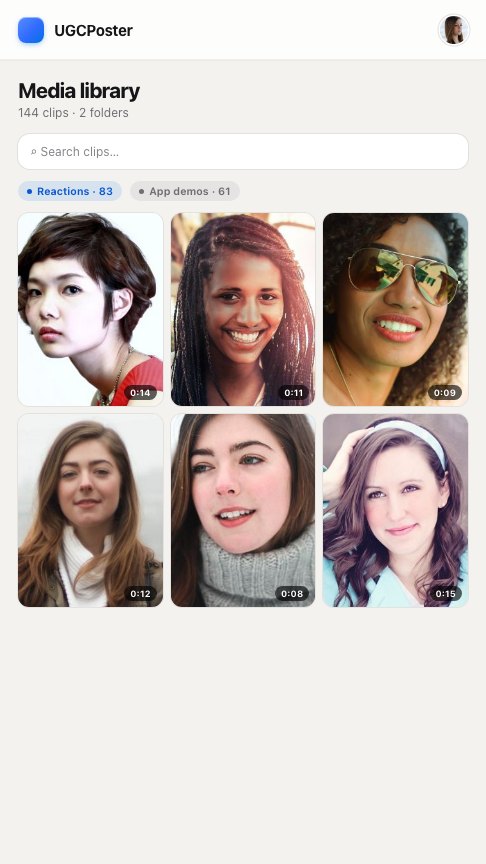
The shoot isn’t usually the slow part. Many creators already have a folder of reaction clips and a few app demos on their phone. The slow part is the daily edit, caption and post loop, multiplied by every account. That limits how many Canvas clients you can run.
UGCPoster is built for that loop. You upload your clips and demos once, connect each account, and it pairs clips, writes a new hook, renders the video and posts it on a schedule, as drafts you approve or directly. It doesn’t find deals or talk to brands. It handles the repeat work so the volume side of Canvas UGC stops capping your client count.
The right deal is the one that pays you more per hour, not per screenshot.
Whichever model you choose, run the numbers on your own deals first, including your time.
FAQ
What does Canvas UGC mean? +
Canvas UGC means you film and post short videos directly on a social account the brand owns, often starting at zero followers. The brand account is the canvas, and you're paid for output, views, or both.
What is the main difference between Canvas UGC and traditional UGC? +
In traditional UGC you deliver scripted, edited video files and the brand decides what to do with them, usually as one-off jobs. In Canvas UGC you post short, repeatable videos on a brand account yourself, usually every day, often for months.
Which pays more, Canvas UGC or traditional UGC? +
It depends on the deal. Traditional UGC usually pays more per video, while Canvas UGC pays less per video but at much higher volume, with videos that take far less time to make. Compare your pay per hour, not per video.
Can I do both Canvas UGC and traditional UGC? +
Yes. Many creators keep a few flat-rate traditional deals for stable income and add Canvas deals for volume and upside. Just check each contract for exclusivity clauses.