Stacking Retainer UGC Deals: How to Run 3–5 Clients
Oct 13, 2026 · 8 min read
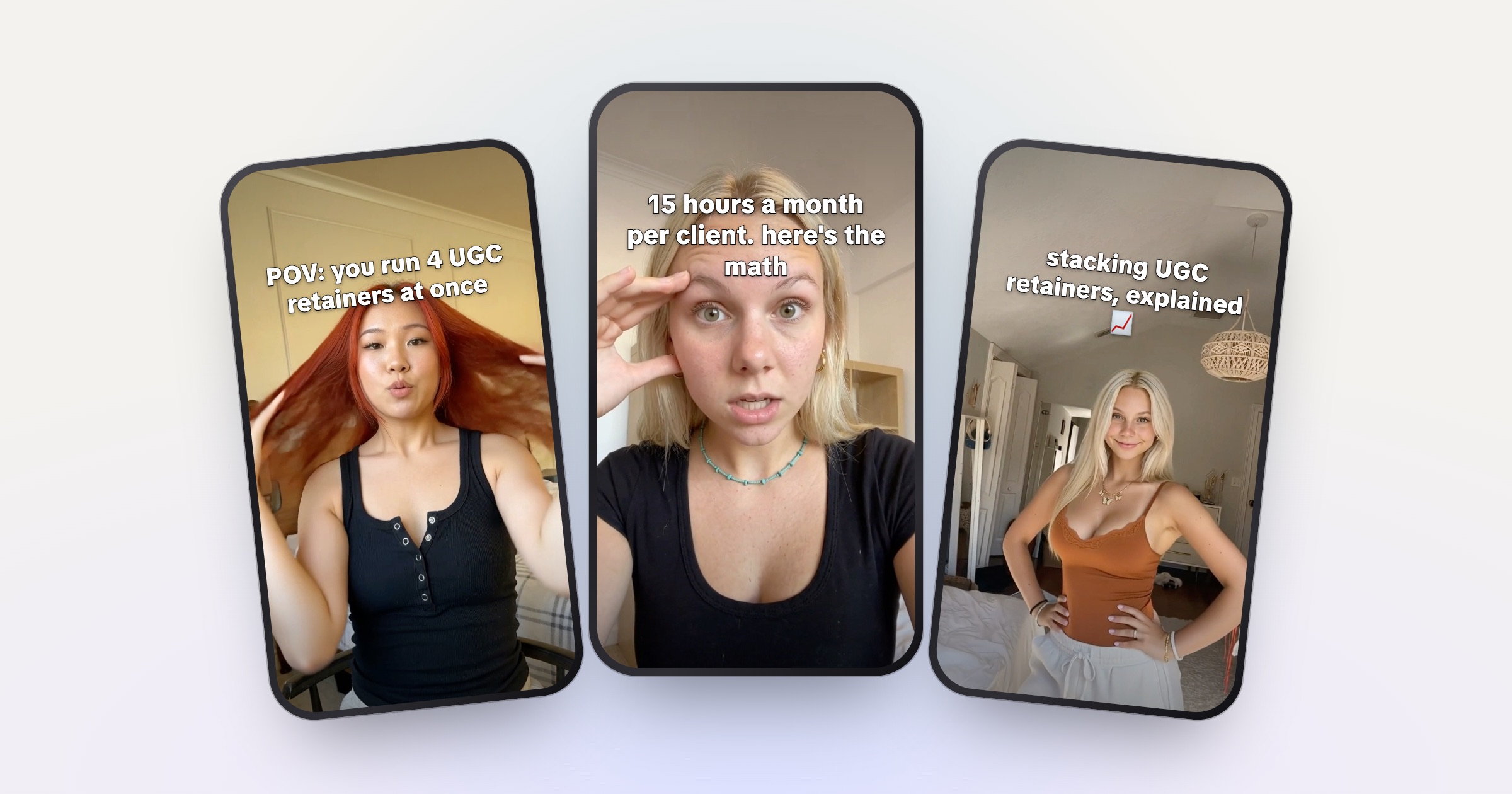
- Stacking means running several monthly retainers with different brands at once.
- Your limit is minutes per post: one daily retainer at 30 minutes a post is 15 hours a month.
- Never stack two competing brands without reading both exclusivity clauses.
- Put volume, pay date, notice, ownership and exclusivity in writing.
Stacking retainer UGC deals means running several monthly retainers with different brands at the same time. It works when three things line up: each post takes you little time, no two clients compete in a way your contracts forbid, and every deal is in writing. Your ceiling is hours per month, not the number of brands that want you.
This guide covers what a retainer is, the time math behind running three to five at once, exclusivity and category conflicts, and the contract terms that keep a stack stable.
- 1 Know your minutes per post It decides how many retainers fit in your month.
- 2 Pick clients that don’t compete Read every exclusivity clause before you sign.
- 3 Get every deal in writing Volume, pay date, notice, ownership, exclusivity.
- 4 Batch across clients One weekly session per task, not one video at a time.
What is a UGC retainer?
A UGC retainer is a monthly deal: a brand pays you a fixed fee for an agreed volume of work. In Canvas and tech UGC, that usually means posting on an account the brand owns, for example one or two posts a day. The deal renews each month until one side gives notice.
Published numbers give a rough idea of the size:
- viral.app reports a median Canvas base of about $500 a month, with bonuses when videos pass view milestones.
- Sideshift gives an example of $600 to $900 a month for 8 to 20 videos.
- Bonus tiers vary by deal. Mackenzie Marsh describes tiers like $100 at 100,000 views, $500 at 500,000 and $1,000 at 1 million.
One retainer at those numbers is a side income, not a living. That’s why creators stack them. Stacking also spreads your risk: if one brand cancels, you lose a slice of your month, not all of it.
Do the time math first
Before you take a second or third retainer, time your current one. Count everything per post: picking clips, writing the hook, editing, the caption, uploading to each platform.
Take a $700 retainer for one post a day as an example. At about 30 minutes per post, start to finish, that’s 15 hours a month for one client, about $47 an hour. Here’s what happens when you stack four of them:
One month, money vs time
Example numbers-
1 retainer, 30 min a post
$47/hour
$700 for one post a day, 30 posts
Earned $700 Hours 15 h Per hour $47 -
4 retainers, 30 min a post
$47/hour
4 × $700, 120 posts
Earned $2,800 Hours 60 h Per hour $47 -
4 retainers, 10 min a post
$140/hour
Same deals, with a clip library and batched edits
Earned $2,800 Hours 20 h Per hour $140
Stacking more clients doesn’t change your hourly rate. Only the minutes per post do. At 30 minutes a post, four daily retainers is 60 hours a month on top of everything else. At 10 minutes, it’s 20 hours. A deal at two posts a day doubles all of it.
The quick formula: posts per month × minutes per post ÷ 60 = hours per retainer. Divide the hours you want to spend on retainers by that number, and you know how many fit.
Volume is what makes this pay. Marsh writes that when she was actively posting, she made $30 a video at 9 videos a day, which she works out to $8,100 a month. That’s only possible when each video takes minutes, not hours.
Check exclusivity and category conflicts
An exclusivity clause stops you working with competing brands for a set period. It’s the main thing that breaks a stack. There are three common versions:
- Competitor exclusivity: you can’t work with named direct competitors. The easiest to live with.
- Category exclusivity: you can’t work with any brand in a category, such as “budgeting apps” or “AI apps.”
- Full exclusivity: you can’t work with any other brand at all. On a small retainer, that’s rarely worth it.
Usually safe to stack
- A budgeting app and a language app
- Non-exclusive deals in any category
- Exclusivity limited to named competitors
- Separate accounts, clips and hooks per client
Check before you sign
- Two apps that solve the same problem
- A clause that bans a whole category
- Full exclusivity on a small retainer
- Exclusivity with no end date
Exclusivity has a price, because it blocks other deals. Sideshift’s guide puts category exclusivity at 20% to 50% of the base rate, negotiated per month, and says it “should always have a clearly defined category” rather than a broad restriction. Elev8or puts category exclusivity at 30 to 50 percent extra.
If a brand wants a broad clause, you have three moves: narrow it to named competitors, shorten it to the length of the deal, or charge for it.
One more trap: footage. If a contract gives the brand all footage you film for it, a reaction clip shot for that client may not be yours to reuse elsewhere. Film your general reaction clips on your own time, and keep each client’s app demos in that client’s folder only.
Put every retainer in writing
A stack is only as stable as its weakest contract. Every retainer should spell out:
- Volume: posts per day, which accounts, which platforms.
- Fee and pay date: plus bonus tiers and how views are counted.
- Exclusivity: the category or named competitors, and for how long.
- Account ownership: who keeps the account, the logins and the followers when the deal ends.
- Usage rights: whether the brand can run your posts as ads. See usage rights.
- Approvals: drafts the client approves, or straight to the feed, and how fast they reply.
- Disclosure: who decides the label. The FTC’s Disclosures 101 is the US starting point.
- Notice period: how much warning either side gives, and how the last month is paid.
In some places a written contract is the law, not just good practice:
- New York City: freelance contracts worth $800 or more in any 120-day period must be in writing. If no pay date is set, you’re owed payment within 30 days of finishing the work.
- New York State: the same $800 rule has applied statewide since August 28, 2024.
- Illinois: written contracts for work worth $500 or more in 120 days, for contracts taking effect after July 1, 2024.
- California: written contracts for freelance work of $250 or more, since January 1, 2025.
A UGC contract template covers the full wording.
This is general information, not legal advice.
Run the week in batches
Four clients at one post a day is 28 videos a week. Done one at a time, that’s 28 rounds of switching between hooks, editing and posting. Done in batches, it’s one session per task.
- 9:00 Hooks
Write 7 hooks per client, in separate lists
- 10:30 Pairs
Match each hook to a reaction and a demo you haven’t used lately
- 12:00 Edits
One template per client, export clean files
- 15:00 Schedule
Load each post into its account’s time slots
Three habits keep a stack clean:
- One folder per client. Reactions can be shared if your contracts allow it. Demos and hooks never are. A travel app hook on a budgeting app’s account is a fast way to lose a client.
- Fixed slots per account. You always know how many videos the week needs.
- A simple tracking sheet. Client, post, platform, views at 48 hours. It’s your proof of work at renewal time, and it shows which hooks to write more of.
The full manual system is in how to post 3 times a day as a UGC creator.
How to land the next retainer
One route to a retainer is turning a one-off job into a monthly deal. After a first batch goes well, offer a monthly package: a fixed number of posts, a fixed fee, a bonus tier. Bring your tracking sheet. Views per post from work you already did show a brand what a month with you looks like.
When you look for new clients, look outside the categories you already serve. A finance app client and a fitness app client can sit side by side. Two finance apps might not, depending on the clauses.
Platforms list ongoing campaigns too. Sideshift, for example, is free to join for creators and supports retainer-plus-bonus payment models. Whatever the source, run the time math before you say yes.
What can go wrong
- Quality slips. If views per post drop as you add clients, bonuses drop too, and renewals get harder. Add one client at a time and watch the numbers for a few weeks before the next.
- Missed days. Four clients means four places to miss a post. Scheduling ahead is what makes a sick day survivable.
- Account problems. A brand account can stop getting views overnight. Ask what happens to your retainer if it does, before it happens.
- Late payments. Keep invoices on a fixed day each month and put the pay date in the contract.
Where the hours go
The time math is where UGCPoster fits. Each client runs as its own project, with its own clips, templates, hooks, schedules and accounts. You upload reaction clips and app demos once. Each run pairs a reaction with a demo, least-used first, writes a fresh hook from your examples, renders the video and posts it to TikTok, Instagram Reels or YouTube Shorts, as drafts you approve or straight to the feed. It doesn’t find retainers or negotiate them. It cuts the minutes per post, which is the number stacking depends on.
Stack slowly, read every clause, and time your posts before you take the next deal.
FAQ
What is a UGC retainer? +
A UGC retainer is a monthly deal where a brand pays you a fixed fee for an agreed volume, such as one post a day on its account. It renews each month until one side gives notice, and many add bonuses when a video passes a view milestone.
How many UGC retainers can you run at once? +
As many as your hours allow without breaking an exclusivity clause. At 30 minutes a post, a one-post-a-day retainer takes about 15 hours a month, so four of them is 60 hours. Cut the minutes per post and you have room for more.
Can I work with two brands in the same category? +
Only if neither contract forbids it. Read each exclusivity clause for the category, the length and who counts as a competitor. If a clause is broad, ask to narrow it to named direct competitors, or charge for it.
How much should I charge for exclusivity? +
Published 2026 guides suggest 20% to 50% of the base rate per month for category exclusivity. The broader the category and the longer the term, the more it should cost, because it blocks other deals.
Do I need a written contract for a UGC retainer? +
You should always have one, and in some places the law requires it. New York City and New York State require written contracts for freelance work of $800 or more over 120 days. Illinois and California have similar rules with lower thresholds.